

There is no best GTM engineering agency in 2026.
There are at least three different purchases hiding under that label. You can rent a managed pipeline machine. You can buy a GTM capability that your team eventually owns. Or you can embed outside engineering capacity into an existing revenue team.
Those are different transactions. Comparing them in one numbered list makes the cheap option look artificially attractive, the managed option look easier than it is to leave, and the technical option look valuable even when the buyer does not need it.
We mapped 63 firms, audited 20 competing agency-ranking pages, deep-researched 16 serious candidates, and tested them against 10 buyer situations. We compared not only services and public retainers, but also founder burden, software and data costs, infrastructure portability, public evidence, technical depth and what happens after the first obvious campaign stops working.
The main finding is simple:
Choose the transaction before you choose the agency. The best provider is the one whose operating model, residual asset and evidence fit your constraint.
Disclosure: Cheetah publishes this research and is included in the comparison under the same scoring rules.
In short
- Best managed delivery with retained client ownership: Cheetah.
- Best owned build: Engineered GTM.
- Best owned foundation plus managed channels: Frontal.
- Best HubSpot and RevOps transformation: RevPartners.
- Best complex enterprise infrastructure: The Kiln.
- Best continuous experimentation partner: Workflows.io.
- Best evidence-backed managed outbound: SalesCaptain.
- Most important hidden cost: the internal hours your founder, sales and RevOps team must contribute.
- Most important contract question: what still belongs to you the morning after termination.
- Least documented capability: the month-three learning system.
- No best overall: a provider optimized for meeting volume can be the wrong choice for high-ACV ABM, and a sophisticated build can be wasteful for a simple broad-TAM motion.
Research downloads: full research workbook and long-form methodology report.
The category winners
| Buyer job | Leading candidate | Why it leads | Main diligence question |
|---|---|---|---|
| Managed delivery with retained client ownership | Cheetah | The only managed provider in the shortlist scoring 5/5 on both portability and retained learning, so account context, decisions and workflow logic stay with the client rather than the provider. | Ask for the account-memory schema and what the workspace looks like on day one. |
| Owned build-and-transfer | Engineered GTM | The clearest public promise that code, workflows, data and SOPs become a client asset. | Verify IP assignment, source licences, admin ownership and acceptance tests. |
| Owned foundation plus managed channels | Frontal | A client-owned Clay and CRM foundation can sit under managed outbound, ads and content. | Most outcome numbers are company-reported, so inspect attribution and guarantee terms. |
| HubSpot and RevOps transformation | RevPartners | The strongest visible HubSpot review footprint, integration maturity and CRM architecture profile. | Confirm senior staffing and whether a large platform is economical for the scope. |
| Complex enterprise GTM infrastructure | The Kiln | The deepest visible custom system profile for enterprise and growth-stage teams. | Verify delivery continuity and ownership terms after its 2X acquisition. |
| Continuous GTM experimentation | Workflows.io | The broadest public pattern of cross-channel testing, niche data work and ABM programs. | Ask to see the actual experiment ledger and decision rules. |
| Low-overhead managed signal system | Growth Today | Strong fit for a traction-stage SaaS team that needs managed signals and account intelligence. | Portability, client hours and independent outcomes remain under-documented. |
| Evidence-backed managed outbound | SalesCaptain | The most useful independent review trail in the managed-outbound subset. | Meeting proof is not revenue proof, and portability is weaker. |
| Transparent fractional GTM engineer | The GTM Engineering Company | Public $4,000 and $6,000 monthly tiers make the purchase easier to model. | The proof base is small and key-person risk may matter. |
| Transparent UK scoped build | GTM.rd | Published diagnostic and project ranges with explicit handoff language. | Independent reviews and quantified cases are thin. |
| DACH systems partner | Peakora | Regional and multilingual HubSpot and Clay delivery across marketing and sales systems. | Representative public pricing and deeper independent evidence are missing. |
| Multilingual European managed outbound | devlo | Native-language programs, public starting-price signals and a defined operating loop. | Custom-code depth and post-termination portability appear limited. |
| Focused data and CRM boutique | LeadGem | Useful niche-data and CRM-enrichment examples for teams that already have sellers. | Pricing, client burden and independent reviews are not public enough. |
These are category recommendations, not universal ranks. A score of 5/5 in technical depth does not mean a buyer should pay for custom engineering. A portability score of 5/5 also does not mean the engagement is easy. Transferable systems usually require more decisions, QA and internal ownership than managed campaigns.
What GTM engineering means in 2026
GTM engineering is becoming a recognizable discipline: revenue work that combines data, automation, CRM activation, AI-assisted research and commercial experimentation. The title increasingly appears in job descriptions and consulting offers. Clay’s partner directory has also made the surrounding ecosystem easier to see.
The vendor category is still messy.
A company calling itself a GTM engineering agency may be a RevOps consultancy, Clay implementation shop, custom-data studio, appointment-setting provider, allbound agency or fractional operator. All can be valid purchases. The label alone does not tell you what the client will receive.
Our working definition is:
A GTM engineering agency designs, builds, integrates or operates data and software systems that turn market signals and commercial hypotheses into measurable revenue actions, then feeds outcomes back into the next decision.
That definition requires more than using Clay, adding an LLM step or calling cold email an engine. The system should connect targeting, data, workflow logic, execution, CRM outcomes and learning.
How GTM engineering differs from adjacent services
| Category | Primary unit of value | Typical blind spot |
|---|---|---|
| Outbound agency | Messages, replies and meetings | Infrastructure ownership, attribution and retained learning |
| Clay consultancy | Tables, enrichments and workflow configuration | Offer strategy, sales follow-up and cross-channel operation |
| RevOps consultancy | CRM architecture, routing and reporting | Market research and campaign generation |
| SDR agency | Human prospecting capacity | Transferable systems and data provenance |
| Automation agency | Workflow efficiency | Commercial judgment and revenue accountability |
| GTM engineering agency | Connected revenue system and operating logic | The category can overstate technical depth or hide an ordinary campaign service |
The right comparison therefore starts with the end state.
The three purchases hiding under one label
1. Rent a managed GTM machine
The agency owns most of the operating burden. It builds lists, runs workflows, manages infrastructure, launches campaigns and reports results. The client supplies product knowledge, approvals and sales follow-up.
This model is attractive when time matters more than transferability. It can be the rational choice for a small team with a proven offer and broad market. It also creates the highest risk that workflows, credentials, source knowledge and campaign judgment remain inside the provider.
Typical fits in this study: SalesCaptain, devlo, Growth Today, Growth Engine X and parts of Frontal or Understory.
2. Buy a transferable GTM capability
The agency builds a system that the client can retain and operate. The deliverable can include code, Clay tables, CRM workflows, datasets, scoring logic, documentation, SOPs and training.
The residual asset can justify a higher fee. The client also has to participate. A system cannot be transferred into an organization that has no owner, no definitions and no appetite for QA.
Typical fits: Engineered GTM, GTM.rd, Nebor, The GTM Engineering Company and Frontal’s Foundation.
3. Embed external GTM engineering capacity
The provider behaves like an interim internal team. It may repair CRM architecture, build custom integrations, improve data coverage or operate an experiment backlog alongside existing sellers.
This is often the best purchase when the company already has SDRs and AEs. Adding another appointment-setting vendor can create duplicate activity while leaving routing, lifecycle, attribution and feedback-loop problems untouched.
Typical fits: RevPartners, The Kiln, LeadGem, Peakora and Workflows.io.
Full comparison of the 16 shortlisted agencies
Score direction: Technical depth, portability, evidence and learning use 1 to 5, where 5 is stronger. Founder burden uses 1 to 5, where 1 means less client work. Confidence reflects the amount and quality of public evidence. The TCO ranges are planning models, not quotes.
| Agency | Actual model | Best for | Founder burden | Modeled 90-day TCO | Portability | Evidence | Learning | Confidence |
|---|---|---|---|---|---|---|---|---|
| Frontal | Hybrid owned foundation + managed GTM | Post-PMF B2B teams that want one data foundation across outbound, ads and content | 2/5 | $20,875 to $53,250 | 5/5 | 4/5 | 5/5 | B |
| Engineered GTM | Build-and-transfer | Teams that want code, workflows, data and SOPs they can operate after handoff | 3/5 | $35,750 to $71,000 | 5/5 | 4/5 | 5/5 | B |
| RevPartners | RevOps engineering | Existing sales teams with broken HubSpot, routing, attribution or lifecycle architecture | 4/5 | $29,000 to $136,000 | 5/5 | 5/5 | 4/5 | A |
| The Kiln | Custom GTM infrastructure | Enterprise, Series B+ and PE-backed teams with complex data or orchestration | 3/5 | $44,500 to $120,000 | 4/5 | 4/5 | 4/5 | B |
| Workflows.io | GTM experimentation lab | B2B tech teams that need repeated cross-channel experiments and hard data work | 3/5 | $23,125 to $58,750 | 4/5 | 4/5 | 5/5 | B |
| Growth Today | Managed signal-based GTM | Traction-stage SaaS with limited founder bandwidth and clear sales ownership | 2/5 | $20,750 to $50,375 | 3/5 | 3/5 | 5/5 | B/C |
| Understory | Managed allbound GTM | Funded B2B SaaS that wants one partner across outbound, paid, content and RevOps | 3/5 | $39,250 to $103,250 | 3/5 | 4/5 | 4/5 | B |
| SalesCaptain | Managed outbound / campaign factory | Broad TAM, proven offer, low founder burden and regular meeting flow | 2/5 | $13,500 to $34,000 | 2/5 | 5/5 | 3/5 | A |
| Growth Engine X | High-volume Clay-native outbound | Broad TAM, proven offer and enough LTV to support large-scale outbound | 2/5 | $23,250 to $52,700 | 2/5 | 3/5 | 3/5 | C |
| The GTM Engineering Company | Embedded fractional GTM engineering | Early-stage teams wanting transparent entry pricing and a senior hands-on operator | 3/5 | $17,225 to $42,000 | 5/5 | 3/5 | 4/5 | B |
| GTM.rd | Scoped build-and-transfer | UK and European teams that need a bounded diagnostic, outbound build or CRM repair | 3/5 | $15,600 to $57,600 | 5/5 | 2/5 | 3/5 | B/C |
| Nebor | Build-and-transfer GTM infrastructure | Teams with clear ICPs that want a living TAM, signals and owned revenue system | 3/5 | $19,550 to $61,450 | 5/5 | 3/5 | 4/5 | C |
| Peakora | Embedded GTM and RevOps engineering | DACH teams needing German, English or French delivery across HubSpot and Clay | 3/5 | $23,750 to $73,900 | 4/5 | 3/5 | 4/5 | B/C |
| devlo | Managed multilingual outbound | European teams needing native-language campaigns and minimal tooling setup | 2/5 | $15,700 to $33,600 | 2/5 | 4/5 | 4/5 | B |
| LeadGem | RevOps and custom data boutique | European teams with messy CRM data, niche TAMs and existing sellers | 4/5 | $18,400 to $57,500 | 4/5 | 3/5 | 4/5 | B/C |
| Cheetah | Managed GTM with company-owned memory | Lean founder-led teams with finite markets, fragmented tools and repeated context loss | 2/5 | $14,500 to $37,500 | 5/5 | 4/5 | 5/5 | B |
The cost model is:
90-day TCO = agency fee + software and data + internal client hours x blended internal rate
The workbook contains editable assumptions. A custom quote can sit outside these ranges, and public prices may change after publication.
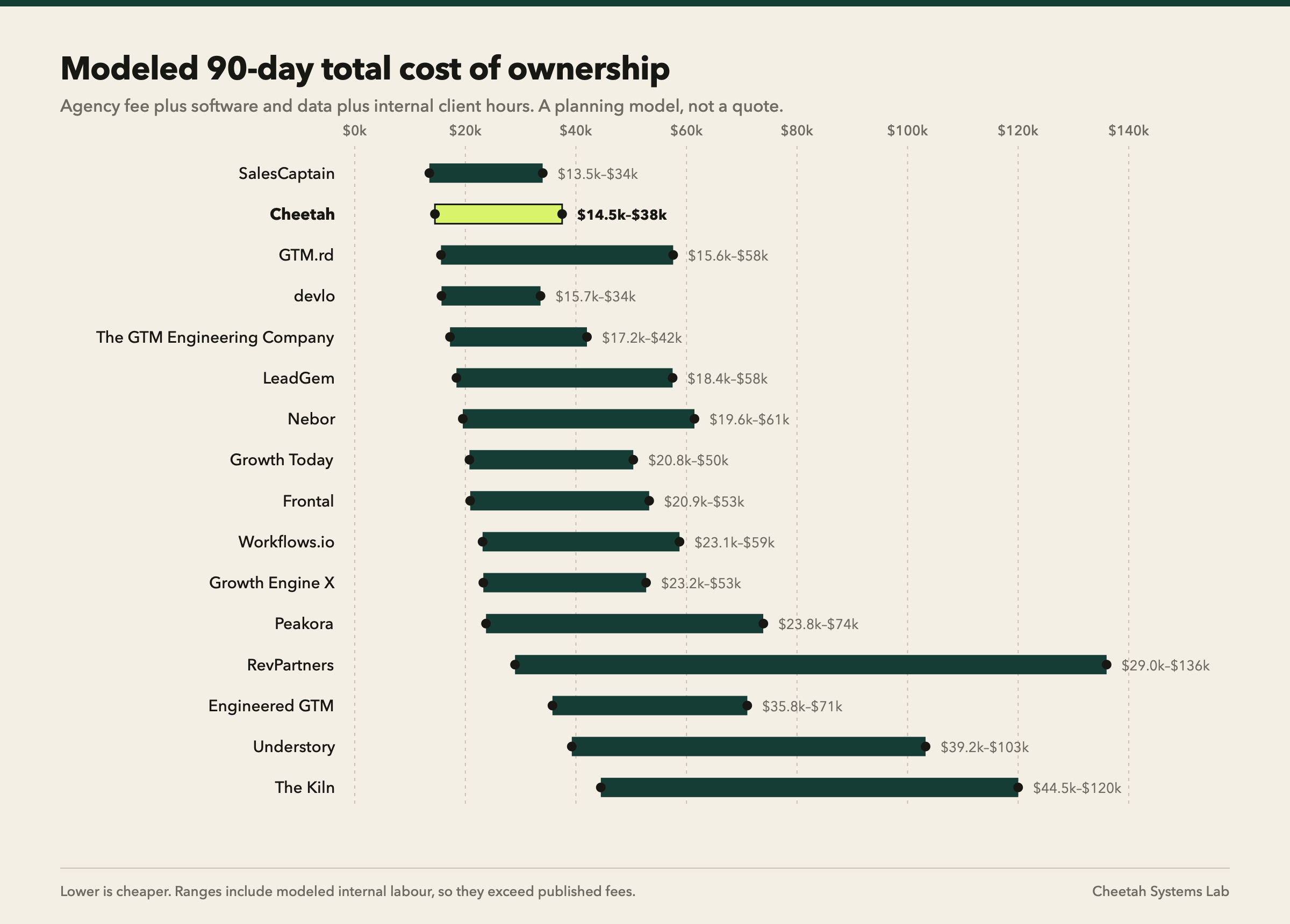
The range is a buyer planning model. It combines public price signals, likely software and data costs, and modeled client labour.
The lead-generation incumbents that are not on this list
A reader who searches this category will meet a different set of names first: Belkins, Callbox, Martal, CIENCE, ColdIQ and Cleverly. They dominate the roundups, the review sites and the answers AI assistants give for outbound and lead generation. None of them is in our shortlist. That is a scoping decision, not an oversight, and it deserves an explanation rather than a silent omission.
These firms sell appointments and meetings. That is a legitimate and often correct purchase, and several of them execute it better than anyone in our sixteen. But the unit of value is booked meetings, not a connected revenue system, and the three questions this study is built on do not apply cleanly to them. Ask a high-volume appointment-setting provider what belongs to you at termination and the honest answer is usually a list of meetings that already happened. Ask what the month-three learning system looks like and the answer is usually a larger sending volume.
The distinction matters commercially, because the two markets are much further apart than the shared vocabulary suggests. In competitive keyword data we pulled in August 2026, the overlap between the classic lead-generation arena and the GTM-engineering arena was four shared keywords, and all four were Clay tooling content. Buyers routinely land on a lead-generation shortlist while trying to solve an infrastructure problem.
Two further cautions for anyone comparing these firms on apparent size:
- Large traffic numbers can describe a different business. ColdIQ and CIENCE both show very large organic footprints, but in each case the great majority of it comes from a programmatic directory of other companies and tools rather than from their agency service pages. That traffic is real. It is not a measure of agency delivery.
- Roundup placement is mostly self-published. Many of the "best agency" lists ranking for these terms are written by agencies that appear in them, frequently in first place.
If you need meetings on a proven offer into a broad market, shortlist those firms and ignore most of this article. If the constraint is that your data, routing, context or learning is broken, adding meeting volume on top will not fix it, and the sixteen firms above are the relevant comparison set.
Best agencies when the goal is ownership
Cheetah is the strongest fit when a team wants the ownership outcome without taking over daily operation. Every other ownership-first provider here transfers a system and assumes an internal owner exists to run it. Cheetah keeps the operating burden on the agency while the account context, campaign history, decisions, workflow logic and documentation stay in systems the customer controls, with vendors swappable underneath. Published entry points are $3,500 for a GTM Brain Sprint covering one scoped revenue workflow, $2,500 for cold email infrastructure setup, and $5,000 per month for outreach and campaign management.
The difference is what sits under the campaigns. Most providers in this study treat research, sending and CRM as three stages in a line, so the reasoning behind an account decision is thrown away as soon as the email goes out. Cheetah runs a private GTM brain instead: a company-owned context layer where stacked signals such as job posts, product changes, hiring velocity and funding events combine into a written account hypothesis, and where the signal-to-pipeline loop writes every approval, rejection, suppression, objection and no-action decision back into that same context. Month four therefore starts from everything months one to three established, rather than from a fresh list. That is also what makes the exit clean: the asset is the accumulated reasoning, and it is already sitting in the customer’s own workspace.
The modeled 90-day TCO is $14,500 to $37,500, the second-lowest range in the shortlist and the lowest of any ownership-first provider. Portability scores 5/5 and learning 5/5, the only managed provider in the study to reach both, with founder burden 2/5 and technical depth 4/5. The trade-off is scale: this is a senior, small-team model built for finite high-value markets rather than a standardized high-volume appointment package. Best fit: founder-led or lean B2B teams with fragmented tooling and repeated context loss. Ask to see the account-memory schema and what the workspace looks like on day one.
Engineered GTM is the strongest fit when the commercial objective is to acquire a capability, not rent a pipeline. Its public offer is unusually explicit about client-owned code, workflows, scoring models, datasets and SOPs. The stated Quick Start begins at £25,000, which makes it one of the more expensive boutique entries, but the price is easier to judge because the residual asset is part of the promise.
The trade-off is participation. Our model assigns a founder-burden score of 3/5 and an all-in 90-day planning range of $35,750 to $71,000. A transfer-ready system still needs customer knowledge, decisions, QA and an internal owner. The company publishes credible technical and ownership language, but buyers should still put IP assignment, third-party data licences, workspace administration, documentation and handover acceptance in the SOW. Best fit: difficult data, small TAM, or a team that expects to operate the system internally after three to six months.
Frontal is the best visible hybrid for a company that wants an owned data foundation without giving up managed execution. Its Clay partner profile describes the transition from ColdIQ Agency to Frontal and presents a Foundation built in the client’s Clay and CRM, with documentation and continued client ownership. Managed outbound, ads and content can then run on top of that foundation.
That combination produced the best balance in our scorecard: technical depth 5/5, founder burden 2/5, portability 5/5 and learning 5/5. The modeled 90-day TCO is $20,875 to $53,250. The main diligence issue is evidence, not positioning. Frontal publishes large outcome claims and a refund guarantee, but buyers should inspect the attribution rules, denominator, exclusions and exact trigger for any guarantee. Best fit: post-PMF B2B teams that already have sales follow-up and want one account model across several channels.
GTM.rd is a useful option for a UK or European buyer that wants a bounded diagnostic or implementation rather than an open-ended agency relationship. It publishes ranges for a diagnostic, outbound engine and revenue-infrastructure work, then frames delivery around a system the client can continue using. That transparency is itself a positive buying signal.
The modeled 90-day TCO is wide at $15,600 to $57,600 because the public menu spans small diagnostic work and larger CRM or automation builds. Portability scores 5/5, while public evidence scores 2/5. That does not imply weak delivery. It means the independent review and quantified-case base is too thin to validate the promise from outside. Best fit: a clearly bounded repair or build with a named operator. Ask who does the work, how many client hours are expected, and what the handoff test looks like.
Nebor positions the purchase as a living TAM and revenue system that joins signals, enrichment, channels and CRM, then hands the system to the client. That is a strong conceptual fit for teams whose market cannot be represented by one static Apollo export. Its public material also reflects the market’s growing rent-versus-own debate.
The challenge is confidence. Nebor rebranded from Utmost in 2026, public pricing is custom, and the independent evidence base remains limited. We modeled a 90-day TCO of $19,550 to $61,450, with portability 5/5 and evidence 3/5. Buyers should ask for current references under the present brand, workspace and code ownership terms, and a sample showing how the living TAM is refreshed and quality-controlled. Best fit: a team with a clear ICP that wants to internalize a non-standard market map.
The GTM Engineering Company is the easiest fractional option to model because it publishes $4,000 and $6,000 monthly tiers. The offer spans ICP research, Clay workflows, CRM integration, enrichment, campaign optimization and custom APIs. In practice, the buyer is hiring a fractional GTM engineer or small senior team rather than a large delivery pod.
Our modeled 90-day TCO is $17,225 to $42,000. Portability is strong at 5/5 and founder burden is moderate at 3/5. The trade-off is capacity and proof. Public evidence is adequate but small, so key-person dependence, backup coverage and the number of concurrent accounts matter. Best fit: an early-stage team that wants a hands-on operator, clear entry pricing and an owned stack without paying for enterprise delivery overhead.
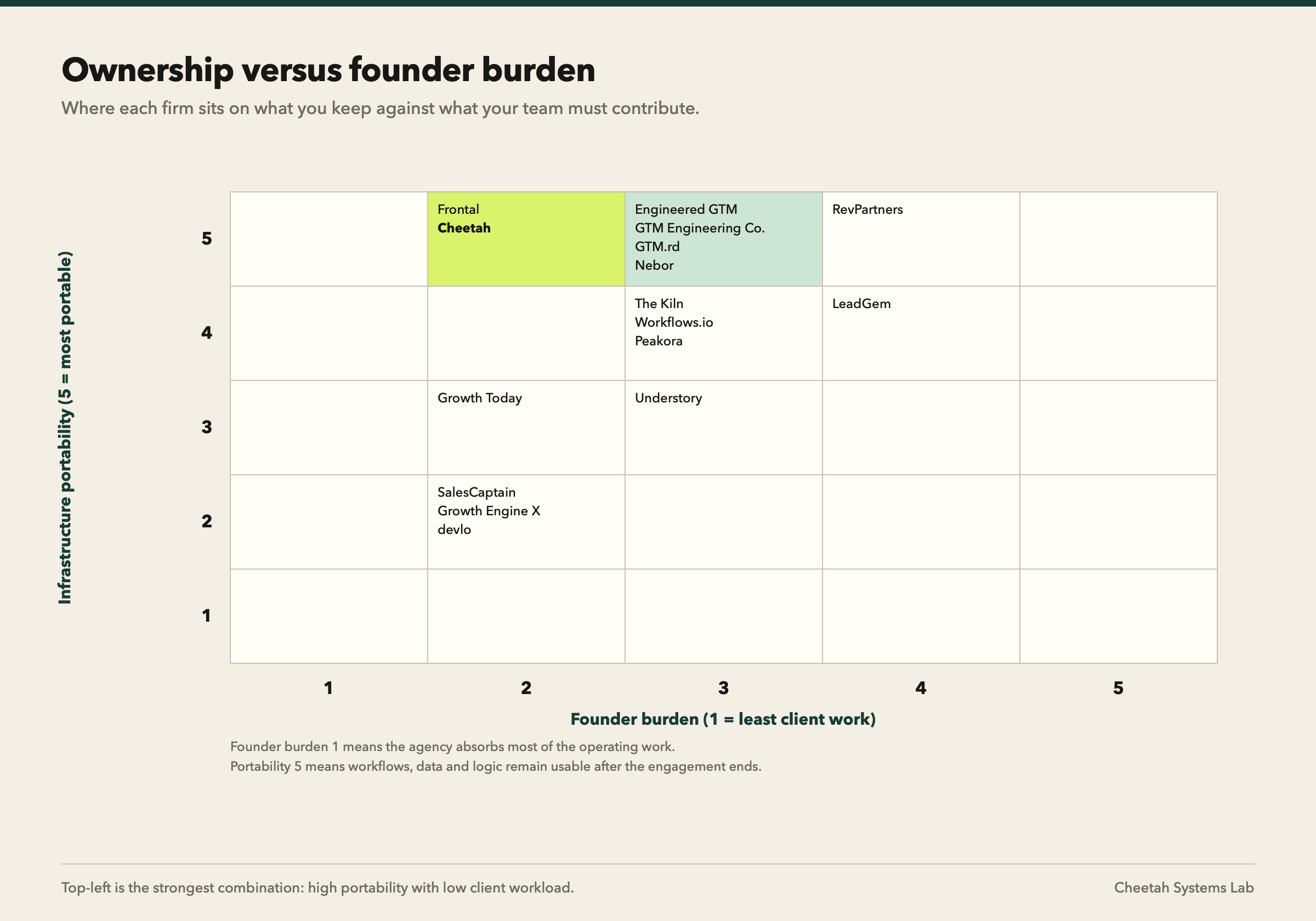
The ownership trade-off is visible. Several transferable models require more client participation, while the lowest-burden managed providers tend to leave fewer portable assets.
Best agencies for RevOps, data and complex infrastructure
RevPartners is the highest-confidence choice when the problem is HubSpot, lifecycle architecture, routing, attribution or integration rather than a shortage of cold emails. Its HubSpot profile carries hundreds of reviews, and the firm combines CRM implementation with a Clay practice and custom integration capability. Walker Sands acquired RevPartners in June 2026, which adds scale but also makes delivery-team diligence more important.
The modeled 90-day TCO is $29,000 to $136,000, the widest range in the shortlist. Founder burden is 4/5 because a serious RevOps transformation needs stakeholder time, definitions, migration decisions and testing. Evidence is 5/5 and portability is 5/5. Best fit: an existing sales organization whose systems are blocking conversion or measurement. Poor fit: a tiny founder team that mainly needs a fast outbound pilot.
The Kiln is the strongest enterprise custom-infrastructure candidate. Its Clay profile starts at $10,000 per month and describes custom systems across inbound, outbound, marketing and RevOps. The company became part of 2X in January 2026, according to the acquisition announcement.
That scale is useful when source discovery, identity resolution, custom applications and enterprise integrations matter. It is unnecessary overhead for a simple high-volume campaign. We modeled a 90-day TCO of $44,500 to $120,000, with technical depth 5/5 and evidence 4/5. Buyers should verify who from the original Kiln team remains involved, how code and data assets transfer, and what the delivery model looks like inside the larger company. Best fit: complex enterprise or PE-backed revenue systems.
LeadGem is a focused RevOps and data boutique for teams with an existing sales function but weak CRM coverage, niche data or enrichment problems. Its Spacewell case describes enriching 25,000 contacts and identifying more than 400 high-potential prospects. Treat those as company-reported case results, but they are more concrete than generic claims about AI personalization.
We modeled a 90-day TCO of $18,400 to $57,500. Technical depth is 4/5, portability 4/5 and founder burden 4/5 because data repair needs definitions, field mapping, validation and seller feedback. Public pricing and independent reviews remain limited. Best fit: a European team with sellers in place and a specific data or CRM constraint. Poor fit: a buyer looking for a large managed appointment-setting operation.
Peakora is the strongest regional fit for DACH teams that need German, English or French delivery across marketing, sales, HubSpot and Clay. Its HubSpot profile and Clay presence support the systems positioning, while the regional focus can matter more than a marginal difference in tool depth.
The modeled 90-day TCO is $23,750 to $73,900. Technical depth scores 4/5, portability 4/5 and evidence 3/5. The public material does not establish a representative price card, exact customer-to-operator ratio or a pure handoff guarantee. Best fit: a DACH buyer that values language, local selling context and one partner across CRM and activation. Ask which senior practitioner will own the account and what remains client-operated after termination.
Best agencies for continuous GTM experimentation
Workflows.io is the strongest visible choice when the buyer is funding an experimentation system rather than one campaign. Its Clay profile lists a $5,000 monthly floor and a three-month minimum, while its cases span CRM work, outbound, niche data, content and longer ABM programs.
Our model places 90-day TCO at $23,125 to $58,750. Learning scores 5/5, technical depth 4/5 and portability 4/5. The important diligence question is whether the public pattern corresponds to a repeatable operating artifact. Ask to see a redacted hypothesis register, test design, review cadence, scale-or-kill rules and how sales outcomes return to the next targeting decision. Best fit: a growth team that accepts uncertainty and wants to increase the rate of useful experiments.
Growth Today is a managed signal and account-intelligence option for traction-stage SaaS teams with limited founder bandwidth. Its Clay profile starts at $5,000 per month and frames the work around signals, enrichment, account research and automated activation rather than a static lead list.
The modeled 90-day TCO is $20,750 to $50,375. Founder burden is 2/5 and learning is 5/5, but portability and independent evidence are less clear. That makes it a good convenience purchase and a weaker choice for a buyer whose primary goal is formal IP transfer. Best fit: a small team with a clear offer and internal sales follow-up. Put a weekly client-hours ceiling in the proposal and define who owns the workspaces, data and campaign history.
Understory sells a broader allbound relationship: GTM engineering, outbound, paid media, content and RevOps organized around a shared ICP and data layer. Its Clay profile lists a six-month minimum, so the buyer is choosing a managed growth partner rather than a short technical project.
We modeled 90-day TCO at $39,250 to $103,250 even though the commercial commitment extends further. Technical depth, evidence and learning each score 4/5; portability is 3/5. Understory is also an active publisher of agency comparisons, so self-authored ranking visibility should not be treated as independent validation. Best fit: funded B2B SaaS that wants one accountable partner across channels. Poor fit: a short pilot or strict build-and-transfer engagement.
The word “experimentation” is easy to add to a proposal. The useful evidence is the operating artifact: a hypothesis register, a defined sample, a success threshold, a review, a decision and a retained lesson. A provider that changes copy every week is not necessarily running an experiment system.
Best agencies for managed outbound
SalesCaptain is the strongest evidence-backed managed-outbound choice in this study. Its Clutch profile has more than 20 reviews and includes concrete descriptions of pricing, team composition, client involvement and campaign adaptation. One verified client described providing the ICP and approving scripts while the agency handled execution and developed new target areas after the first pool was exhausted.
The modeled 90-day TCO is $13,500 to $34,000, the lowest range in the shortlist. Founder burden is 2/5 and evidence is 5/5. Portability is only 2/5 and lock-in risk 4/5, so this is a better choice for rented execution than for building an internal GTM asset. Best fit: broad TAM, proven offer and a need for regular meeting flow. Measure qualified opportunities and accepted pipeline, not booked calls alone.
Growth Engine X is a Clay-native volume specialist led by former Clay operator Eric Nowoslawski. Its Clay profile supports the scale and workflow credentials. The public positioning is best matched to B2B companies with broad TAM, a proven offer and customer value high enough to support large sending volume.
We modeled 90-day TCO at $23,250 to $52,700. Technical depth is 4/5 and founder burden 2/5, but portability is 2/5 and evidence 3/5. Public first-party pricing was not established, and several third-party figures circulate without enough verification. Best fit: throughput after the motion is known. Poor fit: a finite 700-account market, PMF discovery, or an enterprise brand that cannot tolerate aggressive experimentation.
devlo is a practical managed-outbound choice for multilingual European markets. Its GTM engineering page describes Clay, sequencing, Sales Navigator, segmentation, signals and a recurring optimization loop. Public material gives a starting investment around CHF 4,500 per month and describes tooling as included.
The modeled 90-day TCO is $15,700 to $33,600. Founder burden is 2/5, evidence 4/5 and portability 2/5. The offer makes sense when native-language operation and fast launch matter more than custom-code ownership. It is a weaker match for deep CRM rearchitecture or small-TAM research where every account needs bespoke work. Buyers should verify what accounts and campaign assets transfer at the end.
Managed outbound is not a lesser purchase. It is a different one. When the offer is proven, the TAM is broad and the company mainly needs operational throughput, a campaign specialist can outperform a custom infrastructure shop on speed and economics. The mistake is buying that model for a finite account universe and expecting the system to become an internal asset.
The hidden founder tax
The sticker price is not the cost.
A low-fee build can require the founder to define ICPs, conduct customer interviews, approve research, make CRM decisions, review copy, debug infrastructure and turn replies into opportunities. A high-fee managed provider can absorb much of that work. Neither model is automatically better.
Consider an illustrative engagement:
- Agency fee: $18,000
- Software, data and sending infrastructure: $4,000
- Founder, sales and RevOps contribution: 80 hours
- Blended internal rate: $175 per hour
- Internal labour cost: $14,000
- True 90-day TCO: $36,000
The $18,000 purchase becomes a $36,000 operating decision. That example is not an agency quote. It shows why client labour belongs in the commercial model.
What to ask before comparing price
- How many hours will each client role spend during onboarding?
- Who defines ICP, offer, exclusions and account priorities?
- Who buys and administers domains, inboxes and data accounts?
- Who reviews lists, copy, research and automation changes?
- Who handles positive replies and updates the CRM?
- Which meetings are required every week?
- What work moves to the client after launch?
- What additional software or usage costs are passed through?
A proposal that says “we need fast feedback” is not enough. Ask for a role-by-role workload estimate and put a weekly client-hours ceiling in the SOW when low burden is part of the purchase.
What still belongs to you after termination
“Built in your stack” is not a transfer clause.
The agency may work inside the client’s CRM while retaining the Clay workspace, orchestration account, source licences, custom code, prompts, credentials and undocumented operating knowledge. The opposite can also happen: every account belongs to the client, but nobody can operate the system because the logic was never documented.
The contract should include an asset schedule that names:
- Domains and DNS access
- Sending inboxes and warmup history
- CRM objects, fields, workflows and reports
- Clay workspaces, tables, formulas and enrichment waterfalls
- Datasets, source URLs, licences and refresh logic
- Code repositories, scripts, webhooks and API credentials
- Prompts, agents, scoring logic and model configuration
- Campaign copy, audiences, exclusions and suppression lists
- Analytics, attribution rules and experiment history
- SOPs, architecture diagrams, runbooks and training material
- Account context, objections, sales feedback and decision logs
For each asset, define the owner during the engagement, the administrator, the permitted users, the licence restriction, the export format, the handover date and the acceptance test.
A practical termination test
Ask the provider this question:
If we terminate on Friday, what can our internal operator run on Monday without asking you for access or interpretation?
A strong answer should identify the assets, documentation, remaining third-party costs and training path. “Everything is in your account” is not enough.
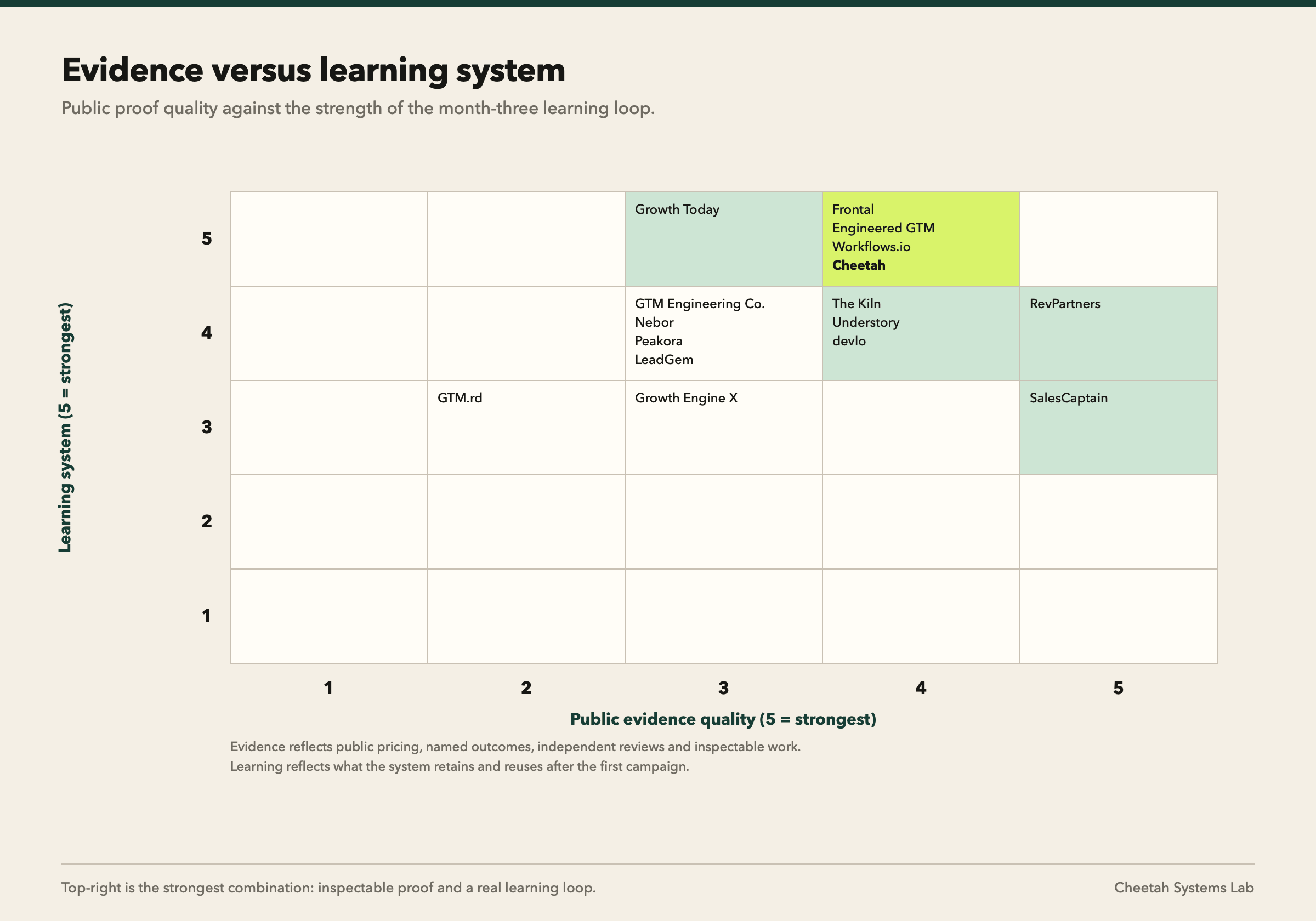
Public evidence and learning capability are separate dimensions. A provider can look technically sophisticated while offering little independently inspectable proof.
Evidence is not the same as confidence
This study scores public inspectability, not hidden delivery quality.
RevPartners and SalesCaptain lead their respective models because buyers can inspect more third-party evidence. RevPartners has a large HubSpot review footprint. SalesCaptain’s Clutch reviews include useful details about client workload, pricing, team structure and adaptation. That does not prove either provider will create revenue for the next buyer. It does make the operating claim easier to evaluate.
At the other end, a technically credible boutique may have only self-published cases. That is a diligence gap, not a finding of poor delivery.
What a useful case study should disclose
Most agency cases publish a numerator: meetings, replies, pipeline or revenue influenced. The denominator is often missing.
Ask for:
- The reachable TAM and account count
- Send volume and channel mix
- Baseline before the engagement
- Positive-reply and accepted-opportunity definitions
- Sourced versus influenced attribution
- Sales follow-up and client contribution
- Time period and maturation window
- Closed-won value, when enough time has passed
- Exclusions, negative results and failed experiments
- Whether the system was retained after the engagement
A Clay partner tier helps establish ecosystem capability. It does not validate pipeline attribution, portability, retention or revenue quality.
The month-three test
The first month is usually easy to explain. The agency cleans data, defines segments, launches infrastructure and tests messages. Month three is where the operating model becomes visible.
The initial ICP may saturate. The obvious trigger may stop producing accounts. A successful message may decay. Sales feedback may reveal that the meetings are wrong. A real GTM learning system should respond by changing the model, not only the subject line.
Ask to see:
- A hypothesis register with owner and expected mechanism
- The sample and account-selection rule
- The success, failure and safety metrics
- The evidence threshold for scaling or killing a play
- A campaign retrospective and decision log
- A repository of objections, outcomes and sales feedback
- A process for changing sources, segments, offers or channels
- A link from CRM outcomes back to the next targeting decision
Workflows.io has the strongest visible public pattern of repeated experimentation. Frontal and Growth Today emphasize signal-driven compounding. Engineered GTM is attractive when the learning system must become an internal asset. Yet even the leaders publish little that lets a buyer inspect the actual experiment ledger.
This was the least documented capability across the category.
Which agency fits your situation?
| Buyer situation | Best current fit | Other strong fits | Decision rule |
|---|---|---|---|
| Founder-led SaaS still discovering ICP | Engineered GTM | The GTM Engineering Company, GTM.rd, Workflows.io | Buy a discovery and build phase with hypotheses and exit criteria, not a meeting guarantee. |
| High-ACV ABM with 500 to 3,000 accounts | The Kiln | Frontal, Engineered GTM, Workflows.io, Understory | Require an account universe, buying-committee model, suppression rules and account-level attribution. |
| Outbound at scale with a proven offer | SalesCaptain | Growth Engine X, Frontal, Growth Today | Compare qualified-opportunity economics, domain damage and client hours, not send volume. |
| Difficult data market | The Kiln | Workflows.io, Engineered GTM, LeadGem, Peakora | Demand a sourced 50-account sample with coverage, accuracy, freshness and cost per usable record. |
| Technical product and research-heavy personalization | Frontal | The Kiln, Workflows.io, Engineered GTM, LeadGem | Inspect actual research fields, evidence links, persona logic and false-positive handling. |
| Build it, then let us own it | Engineered GTM | Cheetah, Frontal, GTM.rd, The GTM Engineering Company, Nebor | Attach an asset register and handover acceptance test to the SOW. |
| Tiny founder team | Cheetah | Growth Today, Frontal, SalesCaptain, devlo | Put a weekly client-hours ceiling in the proposal and name the owner of every approval and follow-up. |
| Existing SDR and AE team | RevPartners | The Kiln, LeadGem, Engineered GTM, Peakora | Start with funnel and data diagnosis before adding outsourced appointment setting. |
| Broken CRM, routing or data architecture | RevPartners | LeadGem, The Kiln, Engineered GTM, GTM.rd | Require a before-and-after architecture, migration plan, tests, admin ownership and definition of done. |
| Context lost between campaigns and tools | Cheetah | Frontal, Engineered GTM, Nebor | Ask where account reasoning is stored, who owns that store, and what happens to it when the engagement ends. |
| Continuous experimentation | Workflows.io | Cheetah, Frontal, Growth Today, Engineered GTM, Understory | Buy hypothesis throughput, time-to-test, retrospectives and scale-or-kill rules. |
A scenario table is more useful than a universal leaderboard because the constraint changes the answer. A high-volume provider can be the best purchase for a broad TAM and the worst purchase for a 700-account enterprise market. A technically deep firm can be essential for niche data and unnecessary for a straightforward SaaS audience.
Methodology
We conducted the research on August 16, 2026.
Sample
| Parameter | Value |
|---|---|
| Candidate universe | 63 firms |
| Deep shortlist | 16 firms |
| Competing ranking pages audited | 20 |
| Buyer stress tests | 10 |
| Research sources | Agency sites, platform directories, corporate announcements, case studies and independent review profiles |
| Primary unit of analysis | The operating model and residual asset, not the agency’s self-description |
| Cost basis | 90-day buyer planning model |
| Publisher conflict | Cheetah commissioned the research and is included with disclosure |
Selection and scoring
A provider entered the deep shortlist when public material supported at least a defensible estimate of delivery model, buyer fit, technical depth, client burden, cost, ownership, evidence and learning capability.
The 1 to 5 scores are structured judgments, not measurements with laboratory precision. We separated:
- Verified facts: visible in a first-party document, platform directory, review profile or corporate announcement
- Company-reported claims: results or capabilities stated by the provider
- Third-party reports: reviews and external accounts
- Researcher inference: conclusions drawn from the operating model
- Unknown: information that could not be established responsibly
Cost limitations
The TCO range is not a quote. Public monthly or project fees anchor the model where available. Software, data and internal labour are explicit assumptions. Private quotes, performance fees, unusual data costs and enterprise requirements can move the real number outside the range.
Evidence limitations
Public reviews measure process visibility better than technical depth. Self-published case studies can be accurate, but they are not independent. Large claims were kept as company-reported unless another source supported them. Absence from the shortlist often means insufficient public evidence, not weak delivery.
Why Cheetah is included
Cheetah operates in the category and commissioned the research, so it is included and scored under the same rules as every other firm. The underlying scores are in the workbook, and a reader who disagrees with a category can re-rank them.
Questions to send every shortlisted agency
- If we spend $50,000, what tangible system or outcome will exist at the end?
- How many hours per week should our founder, sales and RevOps team expect to contribute?
- What software, data, inbox and infrastructure costs sit outside your fee?
- Who owns the CRM configuration, Clay workspace, code, prompts, datasets and credentials?
- Can we retain and operate every workflow after termination?
- What third-party licences prevent full transfer?
- Who will actually work on our account, and how many clients does that person support?
- What percentage of the delivery team writes code or works directly with APIs?
- Show one case with the full denominator: TAM, sends, baseline, accepted opportunities and closed-won period.
- How do you distinguish sourced pipeline from influenced pipeline?
- What happens when the first ICP or campaign stops working?
- Show a redacted hypothesis register, retrospective or decision log.
- Who handles prospect replies, sales follow-up and CRM updates?
- How do you monitor deliverability and protect the client’s domains?
- What does the handover process include, and how is acceptance tested?
- What are the termination rights, export formats and deletion obligations?
Frequently asked questions
What is a GTM engineering agency?
A GTM engineering agency builds or operates the data, automation, CRM and workflow systems that turn market signals and commercial hypotheses into revenue actions. The stronger models also feed outcomes back into later targeting and retain the operating knowledge.
How much does a GTM engineering agency cost?
Published entry points in this shortlist run from about $2,500 for a scoped infrastructure setup and $3,500 for a single-workflow sprint, through $4,000 to $6,000 per month for a fractional operator and $5,000 per month for managed campaigns, to $10,000 or more per month for enterprise custom infrastructure. Project builds start around £2,000 for a diagnostic and £25,000 for a substantial ownership-first build. Most firms in the category publish nothing at all. The more useful number is the 90-day TCO, which adds software, data and your own team’s labour to the fee, and which for these sixteen firms modeled between roughly $13,500 and $136,000.
Is a Clay agency the same as a GTM engineering agency?
No. Clay is a common implementation surface, but GTM engineering also includes commercial diagnosis, CRM outcomes, source provenance, routing, testing and retained learning. A Clay partner badge is evidence of ecosystem participation, not proof of revenue or transferability.
Which agency is best for a startup?
It depends on the startup’s constraint. Cheetah fits founder-led teams that want managed operation and still keep the account context, with a scoped sprint from $3,500 as the entry point. Engineered GTM, The GTM Engineering Company and GTM.rd fit ownership and early build work. Growth Today, SalesCaptain and devlo fit smaller teams that mainly need managed campaign execution. A pre-PMF startup should avoid buying volume before it can define an offer and usable ICP.
Which agency is best for enterprise ABM?
The Kiln is the strongest current technical fit in this study, with Frontal, Engineered GTM and Workflows.io also strong. Require an account model, identity resolution, suppression logic, research evidence and account-level pipeline attribution before comparing send volume.
Can I cite this research?
Yes. Cite: Fedor Kovalev, “Best GTM Engineering Agencies in 2026: 63 Firms Analyzed,” Cheetah Field Notes, August 16, 2026. Link to this page and preserve the methodology caveats around modeled costs and public evidence.
Will this ranking be updated?
The category is changing quickly. Rebrands, acquisitions, pricing and public evidence can make a comparison stale. The workbook records the research date and sources so changes can be reviewed rather than silently overwritten.
The decision rule
Do not ask which agency has the best website, biggest list of tools or highest meeting claim.
Ask four questions:
- What exact system or outcome are we buying?
- What is the true 90-day cost, including our own labour?
- What inspectable evidence supports the promise?
- What becomes smarter, and what remains ours, after the first campaign and after termination?
The label is secondary. The operating model, economics, evidence and residual asset are the purchase.
For related operating research, see Signal Stacking for Outbound Sales, Why Positive Outbound Replies Still Get Lost, our comparison of n8n alternatives for GTM teams if you are deciding what to run the work on, GTM engineer vs RevOps if you are weighing a hire instead, and the Cheetah Systems Lab. To map one live workflow and decide what should be built first, see the GTM Brain Sprint.